Culture/ PHOTOGRAPHY
Antoine Schneck – Headhunter
By Emmanuel Monvidran
Culture/ PHOTOGRAPHY
By Emmanuel Monvidran
To get as close as possible to the men. To photograph them against a black background, without any scenery. And capture their full otherness.
 Berlana - Ethiopia
“I’m not trying to tell a story. I try to give access to the face,” says artist-photographer Antoine Schneck, whose work has been exhibited for some twenty years on picture rails all over the world (New York, Shanghai…). “My father was a maxillo-facial surgeon, and he sometimes gave me the opportunity to attend some of his operations. The memory of his gestures repairing the faces of damaged people, of broken faces… remains engraved in my mind”, confided the brother of novelist Colombe Schneck to the weekly Le Point.
“Being a photographer allows you to get very close to people, which is a delicate thing in everyday life,” continues this graduate of the École Louis-Lumière, who fell into the photography hobby at the age of twelve.
For a time, he worked as a cameraman on television (La Cinq, etc.) and as a photographer for architecture and interior design magazines, before taking his lenses to Africa (Burkina Faso, Mali, Sudan, Ethiopia).
In his luggage is a portable shooting studio, a large Quechua-type tent with four translucent sides, in which he takes portraits of local villagers.
A totally neutral setting, protected from the stresses and strains of the environment. Where, armed with his camera, Antoine immortalizes their looks with surgical precision. And once the shoot is over, the work isn’t over! “In post-production, I use a palette to rework eye reflections, to eliminate from the final touch any visible trace betraying the photographer’s presence on location, or the equipment he uses.” There are even a few trade secrets: “They are directly inspired by tricks that painters have been using since the 12th century, which I gleaned from various paintings in the Louvre Museum.” The sensibility of this photographic approach is not so far removed from painting, in both its procedures and its ends. A subtle work that sublimates the capture of human unveiling, a magical encounter, in the moment, unique. ■
 Sanké Bah - Mali
 Koundou - Mali
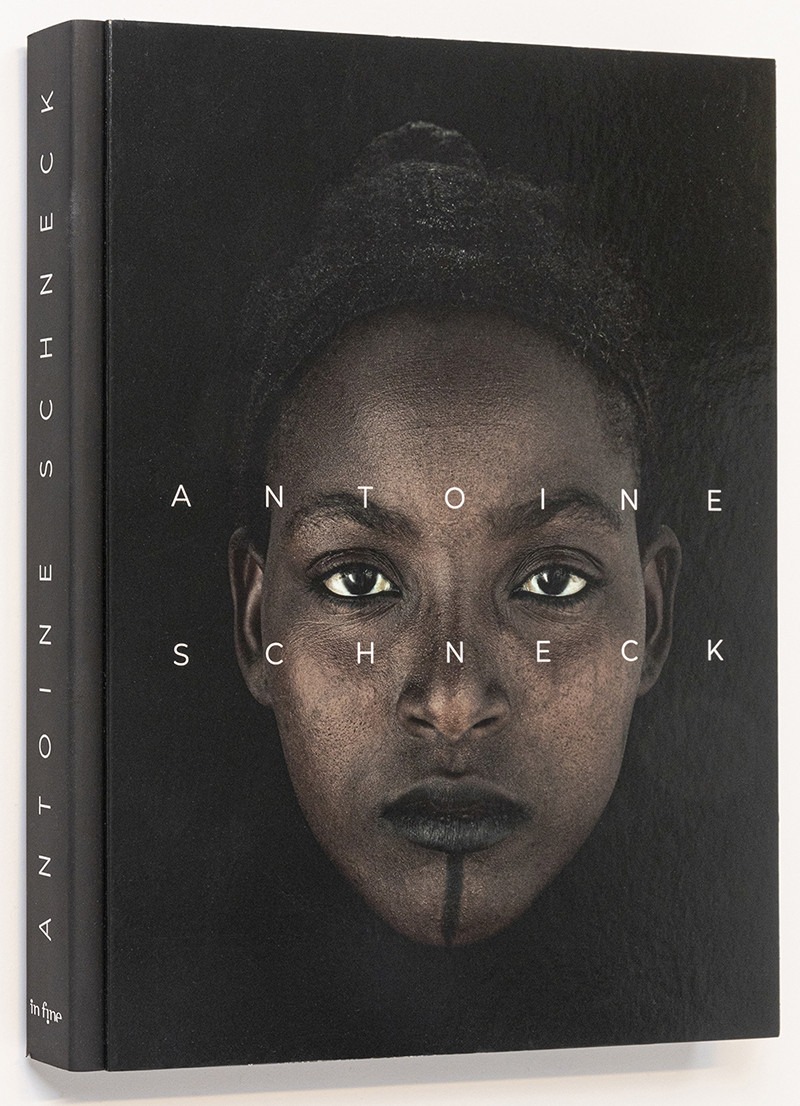
Antoine Schneck,
text by Pierre Wat,
292 p., 180 illustrations, bilingual French-English
(In Fine éditions d’art, €59).
Culture/ PHOTO
Par Emmanuel Monvidran
S‘approcher au plus près des hommes. Les photographier sur fond noir, sans aucun décor. Et réussir ainsi à capter leur pleine altérité.
Berlana - Ethiopie
« Je ne cherche pas à raconter une histoire. Je cherche à donner accès au visage », raconte l’artiste photographe Antoine Schneck, dont le travail est exposé depuis une vingtaine d’années sur les cimaises du monde entier (New York, Shanghai…). « Mon père était chirurgien maxillo-facial, il m’a parfois donné l’occasion d’assister à certaines de ses interventions. Le souvenir de ses gestes réparant la face des personnes abîmées, de gueules cassées… reste gravé dans ma mémoire », confiait à l’hebdomadaire Le Point le frère de la romancière Colombe Schneck.
« En étant photographe, on peut s’approcher très près des gens, chose délicate dans la vie de tous les jours », poursuit ce diplômé de l’école Louis-Lumière, tombé dans la marmite à l’âge de douze ans.
Un temps caméraman de plateaux de télévision (La Cinq…) et photographe pour des magazines d’architecture et de décoration, notre homme transporte ensuite ses objectifs sur le continent africain (Burkina Faso, Mali, Soudan, Éthiopie).
Dans ses bagages, un studio de prises de vues portatif, grande tente de type Quechua à quatre faces translucides, dans laquelle il tire le portrait des villageois du coin.
Un décor totalement neutre, protégé des sollicitations environnantes. Où, armé de son appareil, Antoine immortalise les regards avec une précision… chirurgicale. Et à l’issue du shooting, le travail n’est pas pour autant fini ! « En postproduction, je me sers d’une palette pour retravailler les reflets des yeux, éliminer de la touche finale toute trace visible trahissant la présence du photographe sur les lieux, ou du matériel qu’il emploie. » Il y a même quelques secrets de fabrication : « Ils s’inspirent en droite ligne d’astuces que les peintres utilisent depuis le XIIe siècle, que je suis allé glaner dans diverses toiles du musée du Louvre. » La sensibilité de cette démarche photographique n’est d’ailleurs pas si éloignée de la peinture, dans ses procédures comme dans ses fins. Un subtil travail sublimant la captation du dévoilement humain, une rencontre magique, dans l’instant présent, unique. ■
Sanké Bah - Mali
Koundou - Mali
Antoine Schneck,
texte de Pierre Wat,
292 p., 180 illustrations, bilingue français-anglais
(In Fine éditions d’art, 59 €).